
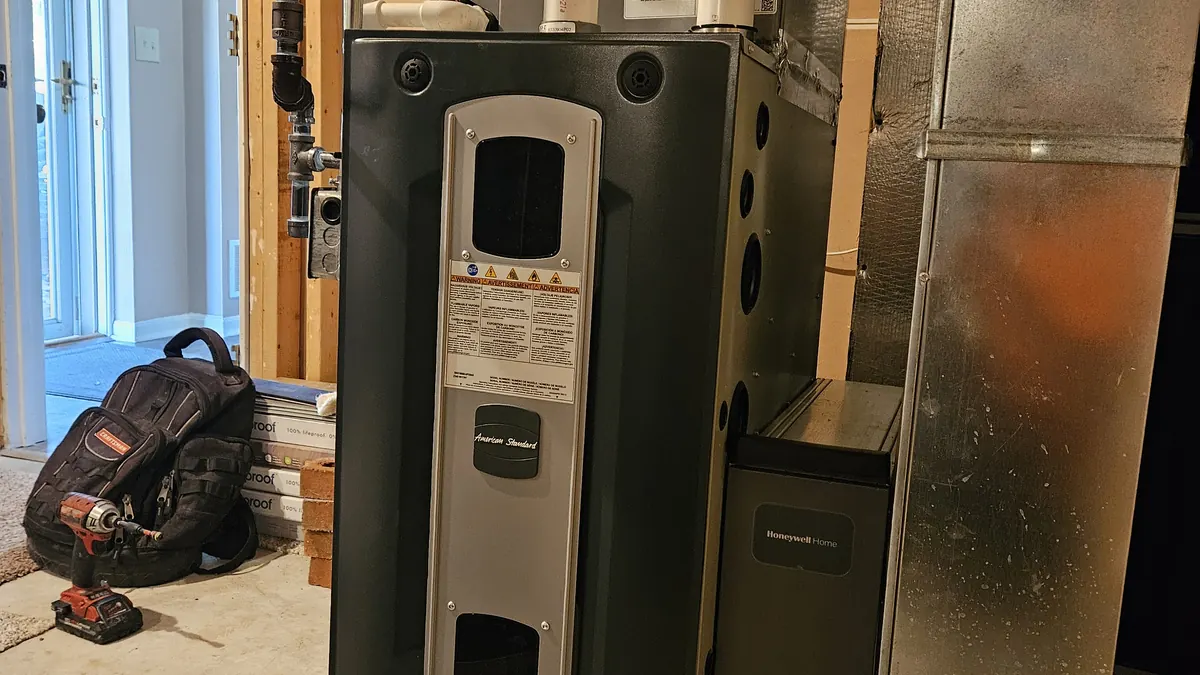
What Just Happened
It snowed overnight, or the temperature crashed, and now the house is cold. Maybe the furnace runs for a minute and shuts back down. Maybe there's a light blinking behind the panel and you have no idea what it means.
One homeowner described it about as clearly as anyone could. "The furnace light near the bottom of the furnace starts blinking a 31 code, three short and one long blink." Same weekend as the first real snow.
On a high efficiency furnace, the most common reason it quits right after a snow has nothing to do with the furnace. It's outside, on the wall of your house, and a broom usually fixes it.
Where Those Two Pipes Are
Go outside and walk the perimeter. You're looking for two white PVC pipes coming straight out of the wall, usually side by side, usually low. Sometimes a couple feet off the ground. Often on the side or the back of the house near where the furnace sits in the basement.
One of those pipes pulls combustion air in from outside. The other pushes exhaust out. That's the whole design of a high efficiency furnace. It doesn't use a chimney and it doesn't take air from your basement.
Some installations run both pipes up through the roof instead of out a sidewall. If you can't find them on any wall, yours go through the roof, and roof terminations are much less likely to drift shut. If you've got an older furnace with a metal flue going up a chimney, this post isn't your problem.
Why a Blocked Pipe Stops the Furnace
The furnace won't light until it proves it can breathe. That's the mechanism, and it's simple.
When the thermostat calls for heat, the inducer fan spins up first and starts pulling air through the burner box and out the exhaust pipe. A small device called the pressure switch senses that airflow. Only when the pressure switch closes does the board allow the ignitor and the gas valve to do anything.
Block either pipe and the inducer can't move enough air. The pressure switch never closes. The furnace either sits there doing nothing or makes a short attempt and gives up. Then it flashes a code and waits.
Nothing about that is a fault. The furnace is refusing to burn gas when it can't confirm the exhaust has somewhere to go. That's the safety design working exactly the way it should. Reading the code the board is flashing narrows it fast, and we walk through what those flashes mean in furnace blinking light codes.
What Actually Blocks Them
Drifted snow. A sidewall termination two feet off the ground disappears under a foot of drift on a windy night. This is the everyday version.
Snow you threw there. Plow piles and snowblower discharge are the sneaky ones. The snow doesn't have to fall on the pipe, somebody just has to throw it at that wall. Driveways in Milford and Amelia where the plow pile ends up stacked against the side of the house account for a real share of these calls.
Ice. This one builds over hours or days instead of all at once. Exhaust from a high efficiency furnace carries a lot of moisture. If the intake sits close enough to the exhaust, some of that moisture gets drawn back in, hits the cold intake pipe, and freezes. Do that through a cold snap and you get a ring of ice slowly closing the opening. Plenty of Anderson Township homes have the two pipes sitting about eighteen inches apart, which is enough in ordinary weather and not always enough in a hard freeze.
Leaves and nests. In fall it's leaves packed against the screen, wasp nests built inside the opening over the summer, and the occasional bird nest. That's why some of these calls come in during the first cold week before it ever snows.
How to Clear Them Safely
Four steps, and none of them need a tool from the garage wall.
- Clear snow well below the pipe openings. Give yourself a foot or more of clearance underneath.
- Open up a couple of feet of space all the way around both pipes, including in front. A tunnel in the snow isn't enough, drifting fills it back in by morning.
- Look up inside both openings. You're checking for ice buildup around the rim and anything nesting in there. A flashlight helps.
- Use a gloved hand or a broom, from outside. Do not jam a stick, a pole, or a shovel handle up inside the pipe. You can crack a fitting or push debris deeper where nobody can reach it.
Two hard rules. Never run the furnace with a vent pipe disconnected, inside or outside, no matter what somebody suggests as a workaround. And if there's ice inside the pipe you can't reach by hand, stop there and call somebody rather than chipping at it.
Once both pipes are clear, cycle the thermostat off and back on. Most furnaces will retry on their own within a few minutes anyway.
Cleared It and It Quit Again
This is the tell that separates a snow problem from a furnace problem, and it comes straight from homeowners who've been through it. If you clear the pipes and the furnace works for a day or two but then shuts off again, even without a new snowfall, it could be a sign of an intermittent problem.
The pipes being clear takes the blockage off the table. So now you're looking at the parts that sense airflow rather than the airflow itself. Usually that's the pressure switch itself getting weak, or the small rubber hose running to it being cracked, pinched, or partly plugged with condensate. Both produce the same behavior, because both make the furnace think it can't breathe when it can.
Same thing applies to a condensate drain that's backing up. A high efficiency furnace makes water when it runs, and if that water can't get out, it can block the very passage the pressure switch is reading. Works fine, then doesn't, then works again after it sits.
None of those are homeowner repairs, but knowing the pattern means you can tell a technician something useful. Cleared the pipes, ran two days, quit again, no new snow. That sentence saves diagnostic time.
Keeping It From Happening Again
Check the terminations after every significant snow. It takes thirty seconds once you know where they are, and it's a lot cheaper than a no heat call on a Sunday.
Tell whoever plows your driveway to keep the pile off that wall. If you snowblow, aim the chute away from it. Both of those are easier to arrange before the season than after.
And if ice keeps forming on the intake winter after winter, that's not really a snow problem. The two pipes may be spaced too close together for the conditions they're getting, and that's an installation question rather than a repair. Sidewall terminations sit low on a lot of the 1990s and 2000s installs across the Cincinnati east side, so it comes up more here than people expect. It's worth having somebody look at how the terminations are arranged instead of clearing ice every January.
If your pipes are clear and the furnace still won't run, we'll come find out what it's actually reacting to. Diagnostic visits are $89, credited toward any repair you approve on the same visit. We work across Anderson Township, Mount Washington, Newtown, Mariemont, Madeira, Loveland, Milford, and Amelia. Call (513) 951-8539 or get in touch here, and our heating services page covers what we handle.