
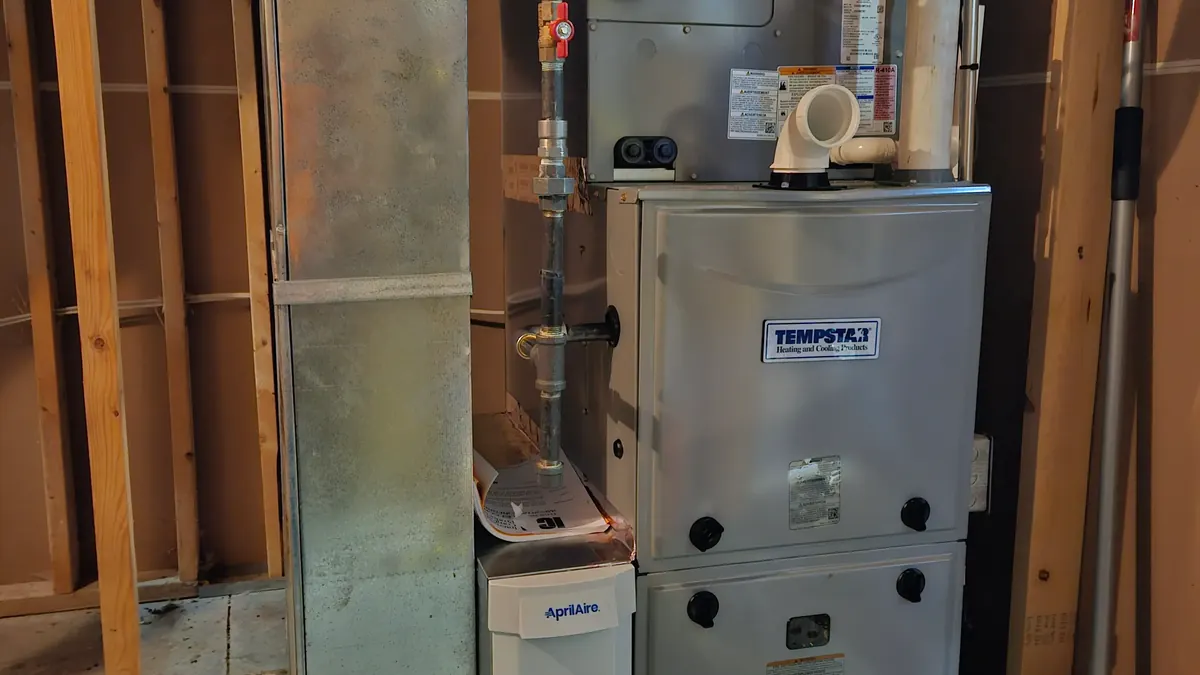
A Faint Whiff at Startup or a Smell That Stays
A strong or steady rotten-egg smell means everyone gets out of the house, now, and you call from outside. A faint smell of gas near the furnace, a quick whiff right at ignition that's gone in seconds, is a different thing. If you're standing in the basement trying to decide which one you've got, you're scared of the house blowing up and scared of calling somebody out for nothing.
- A faint whiff right at ignition that's gone in a few seconds. That can be normal. It still deserves a look at your next service visit, and a call sooner if it's getting stronger or showing up more often.
- A strong or steady rotten-egg smell, or one that hangs around. That's not normal. Don't troubleshoot it. Leave.
Smell in the house right now that isn't going away? Skip to the next section. The rest can wait until you're outside.
Strong Rotten-Egg Smell: Get Out, Then Call
Natural gas has no smell of its own. The utility adds an odorant so you'll notice a leak, and that's the rotten-egg or sulfur smell. If you notice it and it's strong, or it doesn't clear, do this in order:
- Get everyone out. Kids, pets, anyone asleep upstairs. Don't stop to gather stuff.
- Don't flip any switches. Not lights, not the thermostat, not the furnace service switch. Don't unplug anything. A switch makes a small spark.
- Don't light anything. No lighters, no matches, no candles, no starting a car in an attached garage.
- Don't use your phone inside. Make the call once you're outside and away from the house.
- Leave the door open behind you if it's on your way out. Don't go back in to open windows.
- Call Duke Energy's gas emergency line or 911 from outside. Tell them you smell gas and where.
Don't go back in until they tell you it's safe. Don't try to find the leak yourself, and don't shut valves you aren't sure about. That's their call to make, not yours.
After the utility or the fire department has been out, then you call us for the furnace. If they shut off gas to the appliance, we can find out why and fix it. That order matters. Emergency responders first, the HVAC company second.
And about looking stupid: you won't. Nobody who shows up for a gas smell is annoyed that you called. A false alarm costs you a little time. The other outcome doesn't get a second try.
Why a Furnace Can Puff Gas When It Lights
So what about the smell that shows up only when the furnace starts, then fades? It comes down to the startup sequence.
When your thermostat calls for heat, the furnace runs a startup sequence. The draft inducer fan clears the burner area. The igniter heats up or sparks. Then the gas valve opens and gas flows to the burners. If the flame lights instantly and evenly across every burner, you smell nothing.
If ignition is a hair slow, a small amount of gas flows before the flame catches. That little bit can drift up and out, and you catch it near the furnace or at a register. Common reasons ignition lags:
- A dirty flame sensor. The furnace can't confirm the flame, shuts the gas off, and tries again. Each retry can put out another small puff.
- A weak or cracked hot surface igniter. It's not getting hot enough, fast enough.
- Dirty or rusty burners. Flame doesn't carry cleanly from one burner to the next.
- Gas pressure out of range. Too low and the flame struggles to catch. This takes a gauge to check.
Don't confuse this with the burning-dust smell. The first few runs of the season, dust on the heat exchanger cooks off and smells hot or dusty, not like sulfur. We covered that one in why a furnace smells like burning at startup. Burning dust fades over a day or two. A rotten-egg smell at every startup doesn't fade. It keeps happening.
Also, a smell in the vents is different from a smell at the furnace. Your ductwork doesn't carry gas. If you're smelling sulfur at registers upstairs, the air got it somewhere in the basement first, usually near the return intake. That points back toward the furnace area or a nearby gas line or appliance, not the ducts.
Why Older Basements Hide Gas Smells
Around Mariemont, Mount Washington, and Madeira, a lot of houses have older basements with older gas piping. Threaded fittings that've been sitting for decades. A water heater, a dryer, and a furnace all fed off the same run. Sometimes a capped line from an old appliance someone pulled out years ago.
That matters for two reasons. First, more fittings means more places for a slow seep. Second, in an unfinished basement with the furnace pulling return air from nearby, a small leak at the water heater or dryer can show up as a smell at the furnace. You blame the furnace. The source is six feet away.
Cincinnati's weather doesn't help. A mild stretch, then a cold snap, and the furnace goes from idle to running hard in a day. That first real run of the season in November is when a slow igniter or dirty sensor shows itself.
Things People Try That Make It Worse
- Soapy water on fittings by yourself. Bubbles can show a leak, but you're doing it in a space you're not sure is safe. If the smell is strong enough to hunt for, it's strong enough to leave.
- Turning the furnace off and on to see if it happens again. You're repeating the startup that might be putting gas out. Once is information. Five times is a gamble.
- Taking the furnace door off. There's a safety switch behind it, and the parts behind that panel are live. Leave the panels on.
- Assuming a plug-in gas detector would've gone off. A lot of homes have carbon monoxide alarms, not combustible gas detectors. They're different devices. A quiet CO alarm doesn't clear a gas smell.
What Fixes a Gas Smell That Keeps Coming Back
If the smell is only at startup and fades fast, the fix is usually on the cheap end.
A dirty flame sensor gets cleaned. That's often part of a normal tune-up, and it's one reason a yearly visit catches this before it becomes a startup puff. An igniter that's weak gets replaced. Burners get cleaned and checked for even flame. Gas pressure gets measured with a gauge and set where the manufacturer says it belongs. None of that is a big repair.
If the smell lingers, the job is finding the leak. That means checking the gas valve, the fittings at the furnace, the flex connector, and the piping close by. A leak at a fitting is often a tighten-or-replace fix. A bad gas valve gets replaced.
If you want an idea of what these repairs run, our breakdown of furnace repair costs in Cincinnati goes through the common ones. We won't quote a number blind, because it depends on what we find.
What a Good Gas-Smell Visit Looks Like
Call us when the smell is faint, only at startup, and gone in seconds. Call soon if it's getting stronger, happening more often, or you're noticing it farther from the furnace. And if it's strong or steady, you already know the order: out, then Duke Energy or 911, then us.
A good visit for a gas smell should include:
- A gas leak check at the furnace connections and nearby piping with a proper detector instead of a sniff.
- Watching a full startup, start to finish, to see how fast the burners light.
- Checking the flame sensor, igniter, and burners, and cleaning what needs it.
- Measuring gas pressure at the valve.
- A plain answer at the end: what caused it, what fixed it, and whether anything else nearby needs watching.
Renew Mechanical's diagnostic is $89, credited toward a repair you approve on the same visit, and our techs are salaried with no commission, so there's no push to sell you a furnace over a flame sensor. We cover Anderson Township, Mount Washington, Newtown, Mariemont, Madeira, Loveland, Milford, and Amelia. If you've got a startup smell you want checked, book furnace repair and heating service or call us at (513) 951-8539.